When the Model Replaces the System
In January 2026, X, formerly Twitter, open sourced its recommendation algorithm. At the heart of the new system is a Grok-based transformer model, replacing what was almost a textbook example of feature engineering. The model now processes every post and video to determine what should appear in your feed.
It reminds me of Andrej Karpathy’s seminal essay, Software 2.0. In it, he explains how the traditional way of writing code, Software 1.0, is being replaced by neural networks: Software 2.0.
The Old School
Many software systems rely on layers of heuristics to manage complexity. Recommendation systems are a good example. Their primary goal is to show people the content they are most likely to care about. To achieve this, engineers took a divide-and-conquer approach: they turned various signals into features, then combined them in a ranking formula.
But scalability is the real challenge. At X’s scale, more than 100 million pieces of content are generated every day. One of the hardest and most expensive parts of such a system is storing and managing all that data. Over the decades, separate subsystems supporting these features have been researched and developed, including SimClusters, GraphJet, and RealGraph.
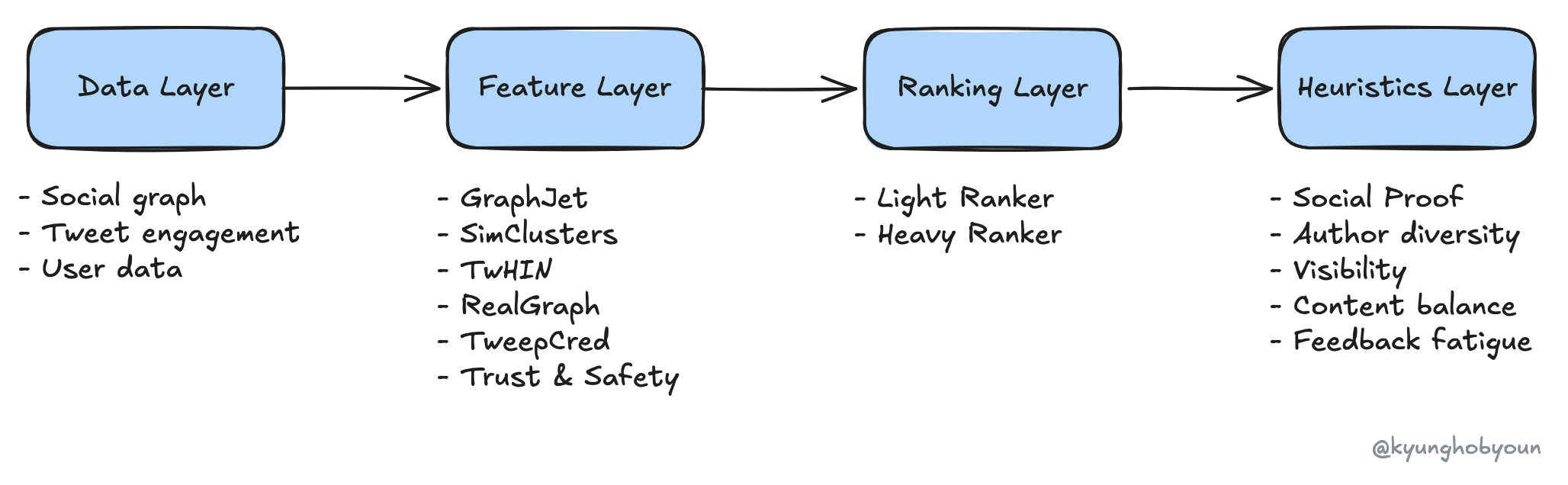
Back to First Principle
Let’s return to the original problem. The real question is what to show people, not how to store the data. Yet X has poured millions of dollars into developing and maintaining the systems around that question.
The key turned out to be a transformer model. Conceptually, a transformer is not so different from feature engineering: it encodes complex information into model weights and turns it into predictions. But its complexity lives in those weights rather than across multiple layers of the surrounding system.
This collapses much of the system’s complexity by reducing the need for specialized data stores and subsystems. Now, instead of rebuilding the entire recommendation stack, X can improve much of the system simply by updating the model weights.
And I’m pretty sure its recommendations will keep getting better. Deep learning models can capture high-dimensional relationships better than hand-written heuristics, and they can improve with more data and the right verifiers. X is also in an unusually favorable position: it already has plenty of training and evaluation data in the form of users’ interaction histories.
The Bitter Lesson
In the near future, I expect more systems to choose neural networks over hand-written code. They are simpler, cheaper, and better than human-designed heuristics.
In that light, I believe the current hype around context engineering and harness engineering is misplaced. They are just more layers of human-written heuristics that will eventually be replaced. It’s a hard truth by The Bitter Lesson: fundamental problems at scale can only be solved with more data and scalable computation.
The model does not merely improve the system. It replaces it.